

DYT 300 Large Marine Surface Cleaning Boat
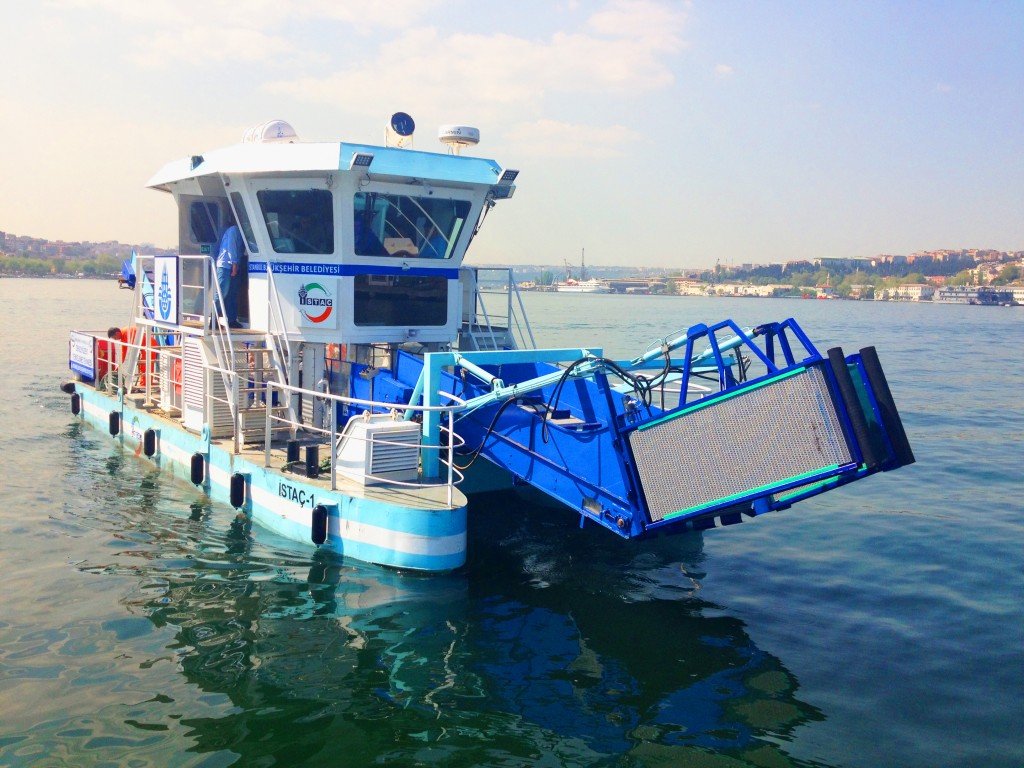
DYT 300 is the flagship of EPS Marine’s large marine surface cleaning boat class — vessels 15 meters and longer. It is a hydraulically driven, fully air-cooled, catamaran-hulled sea sweeper with twin 360-degree azimuth thrusters and 19 m³ of waste storage capacity. DYT 300 collects plastic waste, marine litter, algae and oil-derived pollutants in ports, straits and open-sea conditions, and self-discharges through a 3-line conveyor belt system.
Depending on the market and the terminology used, DYT 300 is also referred to as a trash boat, trash vessel, sea sweeper, sea cleaning vessel, sea clean-up vessel, sea cleaning boat, sea clean-up boat, garbage collection boat, garbage collection vessel, ocean cleaning vessel, or ocean clean-up vessel.
DYT 300 is a 15+ meter, air-cooled catamaran sea sweeper manufactured by EPS Marine (Türkiye), the flagship of EPS Marine’s large marine surface cleaning boat class. It uses twin hydraulically driven 360-degree azimuth thrusters and a 3-line, self-discharging conveyor system with 19 m³ of waste storage capacity to collect plastic waste, marine litter, algae and oil-derived pollutants in ports, straits and open-sea conditions. Its fully air-cooled diesel engines remove any dependency on seawater intake, allowing uninterrupted operation in polluted or debris-filled water beyond the capacity of EPS Marine’s smaller models (Sea Hunter, Sea Hunter Pro, KDYT 100, KDYT 200).
Hull and Propulsion
DYT 300 has a catamaran hull. EPS Marine classifies marine cleaning vessels of 15 meters and longer as large marine cleaning boats; at this size class, the substructure can be built from either steel or aluminum — a steel hull is not mandatory, and a fully aluminum hull can be chosen based on project requirements. On DYT 300, the superstructure is built from aluminum.
DYT 300 uses twin 360-degree azimuth thrusters, fully hydraulically driven. Hydraulic power is generated by two diesel engines, while a separate diesel-electric generator supplies the boat’s electricity. All diesel engines are air-cooled — the vessel has no seawater intake system.
Why an Air-Cooled System?
Marine diesel engines traditionally rely on seawater intake for cooling. Variable engine loads raise marine diesel operating temperatures more than land-based engines, and because marine diesels are designed to run at maximum RPM and load for long periods, they become highly dependent on seawater. DYT 300’s design removes this dependency on seawater entirely.
Marine cleaning boats, sea sweepers and oil/hazardous-substance spill response vessels must operate in polluted, debris-filled waters that ordinary ships avoid — conditions that clog heat exchangers (condensers). On oil spill response vessels (OSRVs) in particular, oil and other hydrocarbon derivatives can coat cooling circuits and reduce cooling efficiency, leaving many response boats unable to operate mid-mission. Deep- and shallow-water intakes do not always solve this problem. DYT 300’s air-cooled design lets it keep operating regardless of particles, plastics and debris in the water.
Seawater’s corrosive properties can also wear down even high-quality condensers, heat exchangers and coolers, causing rust and erosion in the engine room. An air-cooled engine avoids these issues entirely — bilge accumulation, leaking shaft seals and seawater leaks are eliminated. Running an air-cooled diesel engine at sea requires precise HVAC and thermal optimization; EPS Marine’s design has proven itself over years of operation as a distinctive sea sweeper design, regionally and globally.
Maneuvering and Collection Efficiency
DYT 300’s twin azimuth thrusters provide high maneuverability during marine litter and waste collection operations. As a trash boat, DYT 300 is equipped with a 3-line, self-discharging conveyor system, letting it operate continuously and without interruption in high-traffic areas such as ports and straits.
EPS Marine’s large marine surface cleaning vessel class is the choice for high-volume waste collection tasks beyond the capacity of its smaller models (Sea Hunter, Sea Hunter Pro, KDYT 100, KDYT 200). DYT 300 is positioned as both a marine litter collection boat and a vessel with oil spill response capability.
DYT 300 Large Marine Surface Cleaning BoatMain Specifications
| Specification | Value |
| Length Overall (LOA) | 15.40 m |
| Width | 5.30 m |
| Draft | 1.65 m |
| Freeboard | 0.60 m |
| Speed | 8 knots |
| Vessel Type | Catamaran (Hydraulically Driven) |
| Propulsion | 360° Twin Azimuth Thruster (Hydraulic) |
| Main Engine Power | 2 x 300 kW (Air-Cooled Diesel) |
| Generator | 1 x 68 kVA (Diesel-Electric) |
| Cooling System | Fully Air-Cooled (Seawater-Independent) |
| Waste Storage Capacity | 19 m³ |
| Discharge System | 3-Line Self-Discharging Conveyor Belt |
| Hull Structure | Substructure: Steel or Aluminum (Optional) / Superstructure: Aluminum |
Looking for an electric large sea sweeper instead? See our DYT 400 page.
Application Areas
DYT 300 is well suited to the following scenarios:
- Large-scale port and strait cleaning operations
- Open-sea surface cleaning in rough conditions
- Continuous, high-volume municipal and port-authority cleaning programs
- Operations beyond the capacity of smaller models (Sea Hunter, Sea Hunter Pro, KDYT 100, KDYT 200)
- Combined marine litter and oil-spill-derivative pollutant collection
FAQ
Q1: What operations is the DYT 300 sea sweeper suited for?
DYT 300 is designed for large-scale marine surface cleaning operations on vessels 15 meters and longer. It is used in ports, straits, bays and open-sea conditions to collect plastic waste, marine litter, algae and oil-derived pollutants, and is suited to continuous, high-volume cleaning tasks for municipalities and port authorities.
Q2: Why does DYT 300 use an air-cooled diesel engine?
Standard marine diesel engines depend on seawater intake for cooling, which can clog condensers and reduce efficiency in polluted, debris-filled or oil-contaminated water. DYT 300’s fully air-cooled system removes this dependency on seawater, eliminating corrosion, bilge accumulation and shaft-seal leak risks, and enabling uninterrupted operation during response missions.
Q3: What is the hull structure of DYT 300?
DYT 300 is a catamaran-hulled, air-cooled boat. The substructure can be built from steel or aluminum — a steel hull is not mandatory, and a fully aluminum hull can be chosen based on project requirements. The superstructure is built from aluminum.
Q4: What is DYT 300’s waste storage and discharge capacity?
The boat has a 19 m³ waste storage capacity and can self-discharge collected waste through its 3-line conveyor belt system, allowing it to keep operating without depending on shore discharge points such as barges or garbage trucks.
Q5: How maneuverable is DYT 300?
The vessel is fitted with fully hydraulically driven, 360-degree twin Azimuth thrusters. This system provides high-precision maneuvering and positioning during waste collection operations, increasing collection efficiency.