

EPS Marine’s Marpol Barge is a Bureau Veritas (BV) classed, Category D vessel that combines port waste reception with emergency oil spill response in a single hull. Built in carbon steel, 19.60 m in length and rated at 130 GT, it carries the BV notation “I + HULL . MACH — Special Service: Garbage & Oil Spill Collection,” reflecting its dual role as both a MARPOL waste reception barge and an Oil Spill Recovery Vessel (OSRV).
Depending on the market and terminology used, the Marpol Barge is also referred to as a waste collection vessel, bilge water collection vessel, ship waste reception vessel, oil recovery vessel, port waste reception facility vessel, or oil spill response vessel.
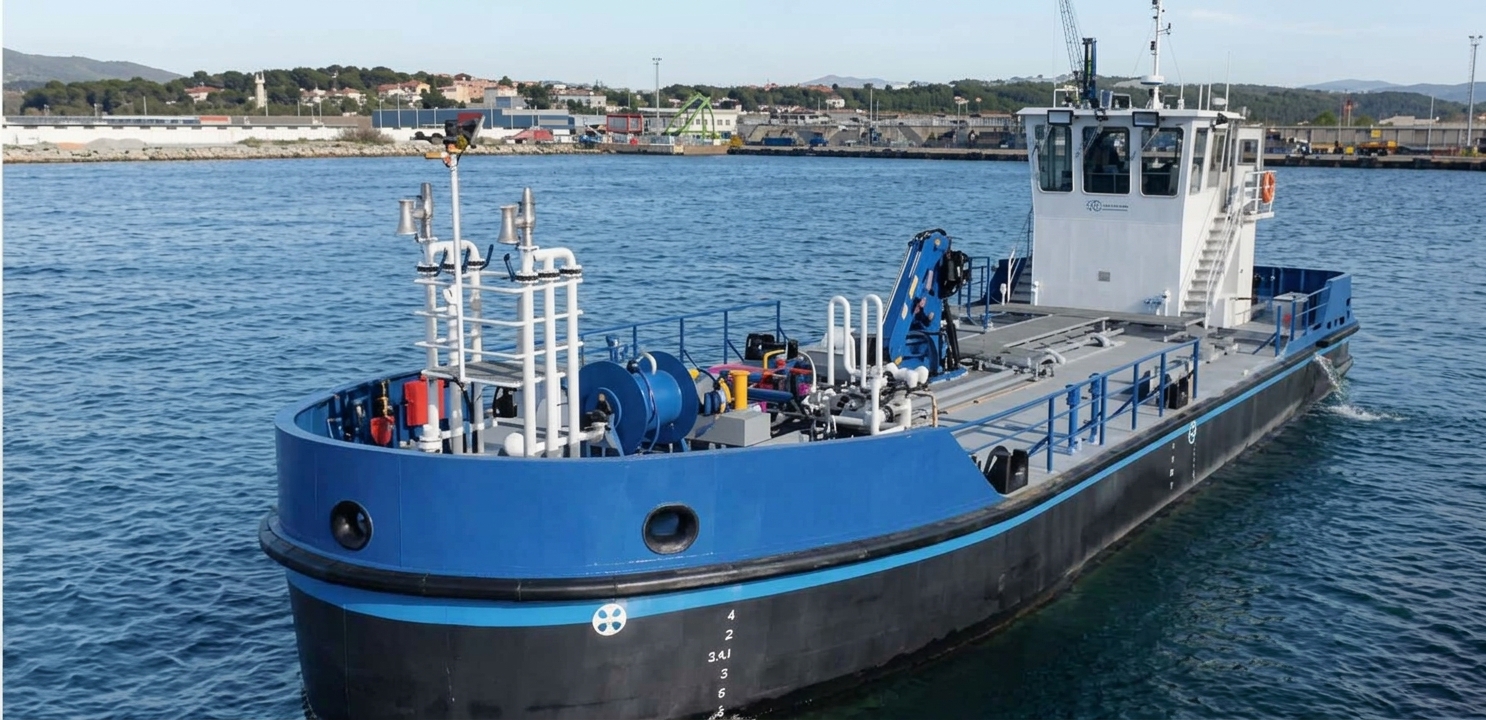
What Is a Marpol Barge? – Regulatory Context
Under the MARPOL 73/78 Convention, ratified by the large majority of flag and port states, governments are required to provide adequate port reception facilities so that ships can legally discharge oily wastes (Annex I), sewage (Annex IV) and garbage (Annex V) instead of dumping them at sea. The Marpol Barge is built to fill that role: its 25,000-litre bilge/oily-water tank, 1,000-litre sewage tank with transfer pump, and 4 m³ garbage tank let a single vessel receive all three regulated waste streams from a ship alongside. A separate 25,000-litre oil recovery tank, a Ruby oil skimmer, and 200 metres of inflatable oil boom add a second capability: on-call oil spill response for the port, terminal, refinery or shipyard it serves. Equivalent domestic rules exist in most maritime nations — for example, the U.S. requires “adequate reception facilities for oil, noxious liquid substances, and garbage” under 33 CFR Part 158.
Technical Advantages
- Self-propelled on twin Volvo Penta D6 (D7C-BA) 400 HP main engines (or equivalent) with ZF 280 gearbox — no tug required for independent port and near-coastal operation.
- A 25,000 L bilge/oily-water tank and a separate 25,000 L dedicated oil recovery tank — routine ship-waste reception and emergency oil recovery are stored without cross-contamination.
- Ruby Oil Skimmer with a 20 m³ lobe pump, paired with 200 metres of TPU inflatable oil boom (ASTM-Z connectors, 25 m sections) on a hydraulic reel for fast deployment and retrieval.
- Fassi Marine F-40BFM.022 hydraulic crane — 7.80 m boom (with extension), 370° rotation, 3.87 t·m lifting capacity — for independent boom and equipment handling on site.
- Full navigation suite: Simrad HALO 20 radar, Simrad G09 MFD with echosounder, Lowrance Link-6S DSC VHF with GPS, EPIRB, SART.
- Fixed CO2 fire suppression, fire alarm system, and dual emergency battery banks (200 Ah x 2) for compliance with safety standards.
- Enclosed wheelhouse, 18,000 BTU Mitsubishi Electric air conditioning, and a sun-block system on the wheelhouse for crew comfort on long shifts.
Use Cases
The Marpol Barge is suitable for the following scenarios:
- MARPOL Annex I/IV/V waste reception from vessels in port (bilge/oily water, sludge, dirty ballast, waste oil)
- Sewage transfer from ships alongside a berth or terminal
- Garbage collection from vessels and yachts
- Oil spill response and recovery for ports, refineries, tank farms and shipyards
- Standby emergency asset for terminal operators and port authorities
- Licensed waste reception service for port authorities and municipalities
Technical Specifications
| Specification | Value |
|---|---|
| LOA | 19.60 m |
| Beam | 8.00 m |
| Depth | 3.00 m |
| Draft | 2.50 m |
| Gross Tonnage | 130 T |
| Class | Bureau Veritas (BV) |
| Notation | I + HULL . MACH — Special Service: Garbage & Oil Spill Collection |
| Navigation Area | A1 |
| Main Engine | 2 x Volvo Penta D6 (D7C-BA) 400 HP @ 2300 rpm or equivalent |
| Gearbox | ZF 280, ratio 2.47:1 |
| Propeller | 1200 mm dia., 4-blade Mn.Br Cu3 x 2 |
| Main Shaft | Duplex stainless steel x 2 |
| Fresh Water Tank | 1,000 L |
| Sewage Tank | 1,000 L |
| Fuel Tank | 4,000 L x 2 (8,000 L total) |
| Bilge Water Tank | 25,000 L |
| Oil Spill (Recovery) Tank | 25,000 L |
| Garbage Tank | 4 m³ |
| Bilge & Fire Pump | 2.2 kW, 18 m³/h |
| Other Pumps | Sewage transfer pump, portable bilge pump, manual bilge pumps |
| Generator | Sole-14 GSC with canopy, 13.9 kVA x 2 |
| Electrical System | Main switchboard + Variable Frequency Drivers, watertight door indicating system |
| Batteries | Emergency 200 Ah x 2 / Service 100 Ah x 2 |
| Hydraulic Crane | Fassi Marine F-40BFM.022 — 7.80 m boom (with extension), SWL 435 kg·m @ 7.80 m, 370° rotation, 3.87 t·m total |
| Oil Skimmer | Ruby Oil Skimmer, 20 m³ lobe pump |
| Oil Boom | 200 m inflatable TPU, ASTM-Z connectors, 25 m sections, hydraulic reel |
| Steering Gear | Hydraulic steering system with emergency steering system |
| Navigation | Simrad HALO 20 Radar, Simrad G09 MFD (echosounder), Lowrance Link-6S DSC VHF (GPS), Simrad Speed Log, GS25 compass antenna, magnetic compass, Plastimo SX-400 handheld VHF, EPIRB, SART |
| Fire Fighting | Fire pump, fixed CO2 system, fire alarm system, CO2 extinguisher 8 kg x 3, dry powder 10 kg x 2 |
| Anchor & Windlass | 100 kg VHPP full-balanced BV COI anchor, hydraulic windlass |
| Painting | Jotun paint system, Sea Quantum Ultra S antifouling |
| Other | 18,000 BTU air conditioning (Mitsubishi Electric), 1000 W search light, 2x life buoy, first aid kit, engine room air blowers 4,800 m³/h |
Marpol Barge or Sea Hunter / DYT Series?
The Marpol Barge serves a different operational need than EPS Marine’s Sea Hunter / DYT series marine cleaning vessels:
| Feature | Marpol Barge | Sea Hunter / DYT Series |
|---|---|---|
| Primary role | Ship-sourced MARPOL waste reception + oil spill response | Floating surface litter/debris collection |
| Hull type | Steel barge hull | Catamaran hull |
| Waste source | Ship-generated (bilge water, sewage, garbage) | Sea surface (plastic, algae, floating debris) |
| Oil recovery | Integrated skimmer + 200 m boom + hydraulic crane | Not fitted |
| Typical operator | Port authority, terminal, refinery, shipyard | Municipality, marina, harbor operator |
Frequently Asked Questions
What is the Marpol Barge used for?
It is a Bureau Veritas classed barge designed to receive MARPOL-regulated waste (bilge water, sewage, garbage) from vessels in port, and to respond to and recover oil spills when needed.
What types of waste can it receive?
Its 25,000-litre bilge water tank, 1,000-litre sewage tank and 4 m³ garbage tank let it store MARPOL Annex I, Annex IV and Annex V waste streams separately.
What is its oil spill response capacity?
The vessel carries a Ruby Oil Skimmer with a 20 m³ lobe pump and 200 metres of inflatable oil boom in 25 m sections, deployed and retrieved via a hydraulic reel; recovered oil is stored in a separate 25,000-litre tank.
Is the vessel self-propelled?
Yes. Twin Volvo Penta D6 (or equivalent) 400 HP diesel engines with a ZF 280 gearbox give it independent propulsion, so it can operate in port and near-coastal waters without a tug.
How is the boom and equipment handled on site?
A Fassi Marine F-40BFM.022 hydraulic crane with a 7.80 m boom and 370° rotation is fitted for handling the oil boom and other equipment.
Which classification society certifies it?
Bureau Veritas (BV), notation “I + HULL . MACH — Special Service: Garbage & Oil Spill Collection,” approved for Navigation Area A1.
What crew comfort features does it have?
An enclosed wheelhouse, 18,000 BTU Mitsubishi Electric air conditioning, and a sun-block system over the wheelhouse.
How is the Marpol Barge different from EPS Marine’s Sea Hunter/DYT series?
The Sea Hunter/DYT series are catamaran-hulled vessels that collect floating surface litter with a conveyor system. The Marpol Barge is a steel-hulled vessel built to receive ship-generated MARPOL waste and respond to oil spills — a different operational need.
Quick Summary
The EPS Marine Marpol Barge is a 19.60 m, 130 GT, Bureau Veritas classed Category D vessel serving as both a MARPOL waste reception barge and an Oil Spill Recovery Vessel (OSRV). Self-propelled on twin Volvo Penta D6 400 HP engines, it carries 25,000 litres of bilge/oily-water capacity, 25,000 litres of dedicated oil recovery capacity, and 4 m³ of garbage storage. Onboard equipment includes a Ruby oil skimmer, 200 metres of inflatable oil boom, and a Fassi Marine hydraulic crane with a 7.80 m boom. It is used by ports, terminals, refineries and shipyards for MARPOL waste reception and oil spill response.