

Jellyfish Boom
The EPS Jellyfish Boom is a floating barrier with an integrated net curtain. The net hangs from the boom down to the seabed and is held in position by a ballast chain, keeping jellyfish and floating debris out of the protected area. It has two main applications: protecting the sea-water intakes of power and industrial plants, and protecting swimming areas at hotels, beaches and marinas.
What Is a Jellyfish Boom and How Does It Work?
The floating part of the boom stays on the water surface, while the net curtain hangs from the bottom of the boom down towards the seabed. A galvanised ballast chain along the lower edge of the net keeps the curtain vertical and in place. Jellyfish and floating debris cannot pass through the net, so the protected area stays clear.
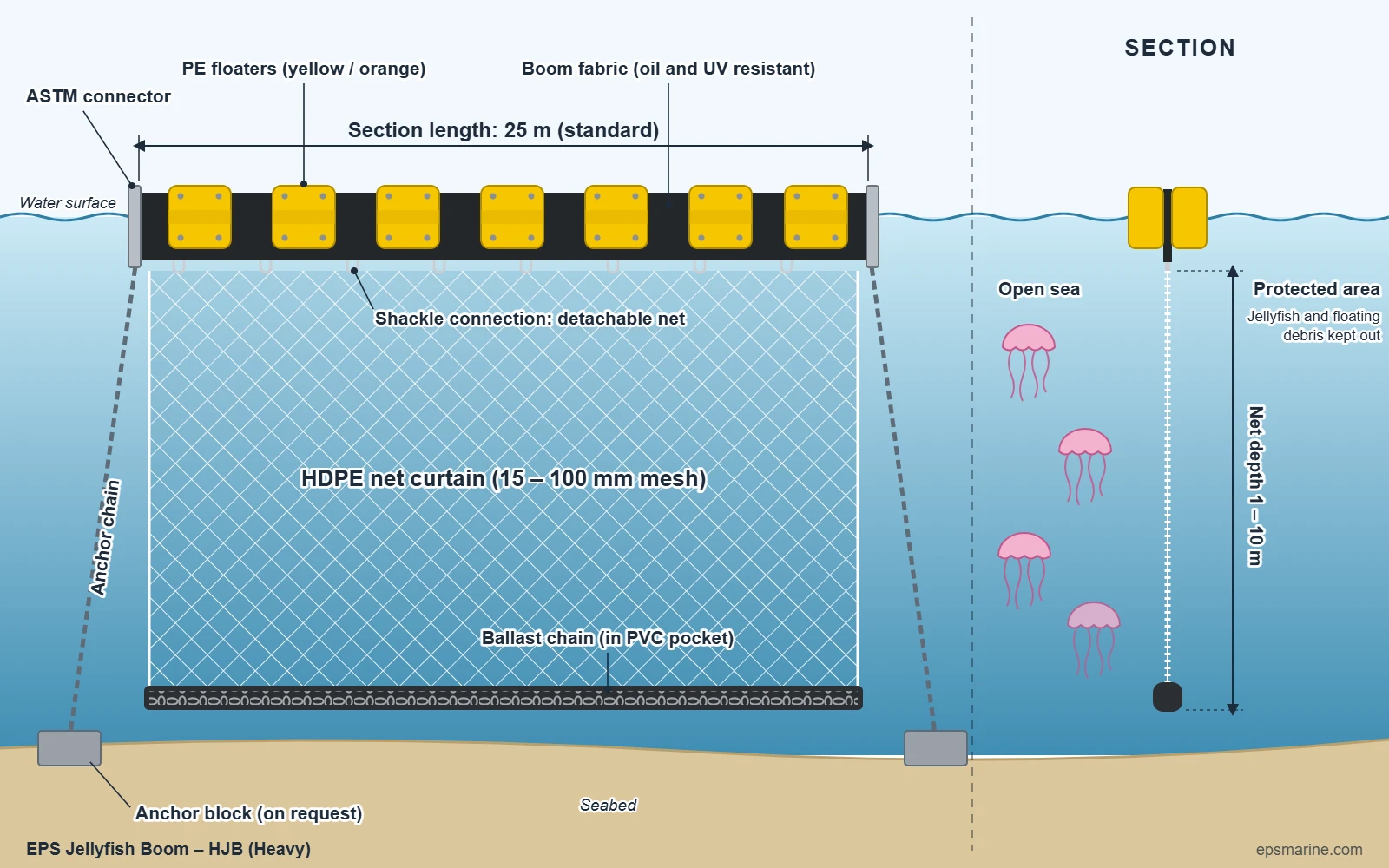
The EPS Jellyfish Boom is offered in two models, so the barrier can be matched to the site conditions and the expected service life. Both models are supplied as standard in 25 m sections; section length, net depth and mesh size can be modified according to the requirements of the project.
Two Models: HJB and LJB
| Feature | HJB – Heavy Jellyfish Boom | LJB – Light Jellyfish Boom |
| Construction | 2-in-1: permanent oil boom and jellyfish net | Lightweight foam-filled net boom |
| Installation | Permanent, year-round; exposed locations | Seasonal or sheltered locations; quick deployment |
| Net | Depth 1 – 10 m, to suit the water depth | Total height 500 – 3000 mm (LJB 1500: 1500 mm net height) |
| Mesh size | 15 x 15 mm – 100 x 100 mm | 20 x 20 mm standard; 15 x 15 mm – 100 x 100 mm available |
| Net connection | Detachable; shackles along the bottom of the boom | Integrated with the boom |
| Section length | 25 m standard | 25 m standard |
Jellyfish Barrier for Power Plant and Industrial Water Intakes
Jellyfish are a serious operational problem for plants that use sea water for cooling. A massive jellyfish influx can quickly clog the primary screens and drum filters of the intake; cooling water flow drops and the plant may have to reduce output or shut down. Publicly reported cases have shown power plants shutting down or reducing output on several units at once because of jellyfish influxes, with incidents recurring in consecutive years at some sites.
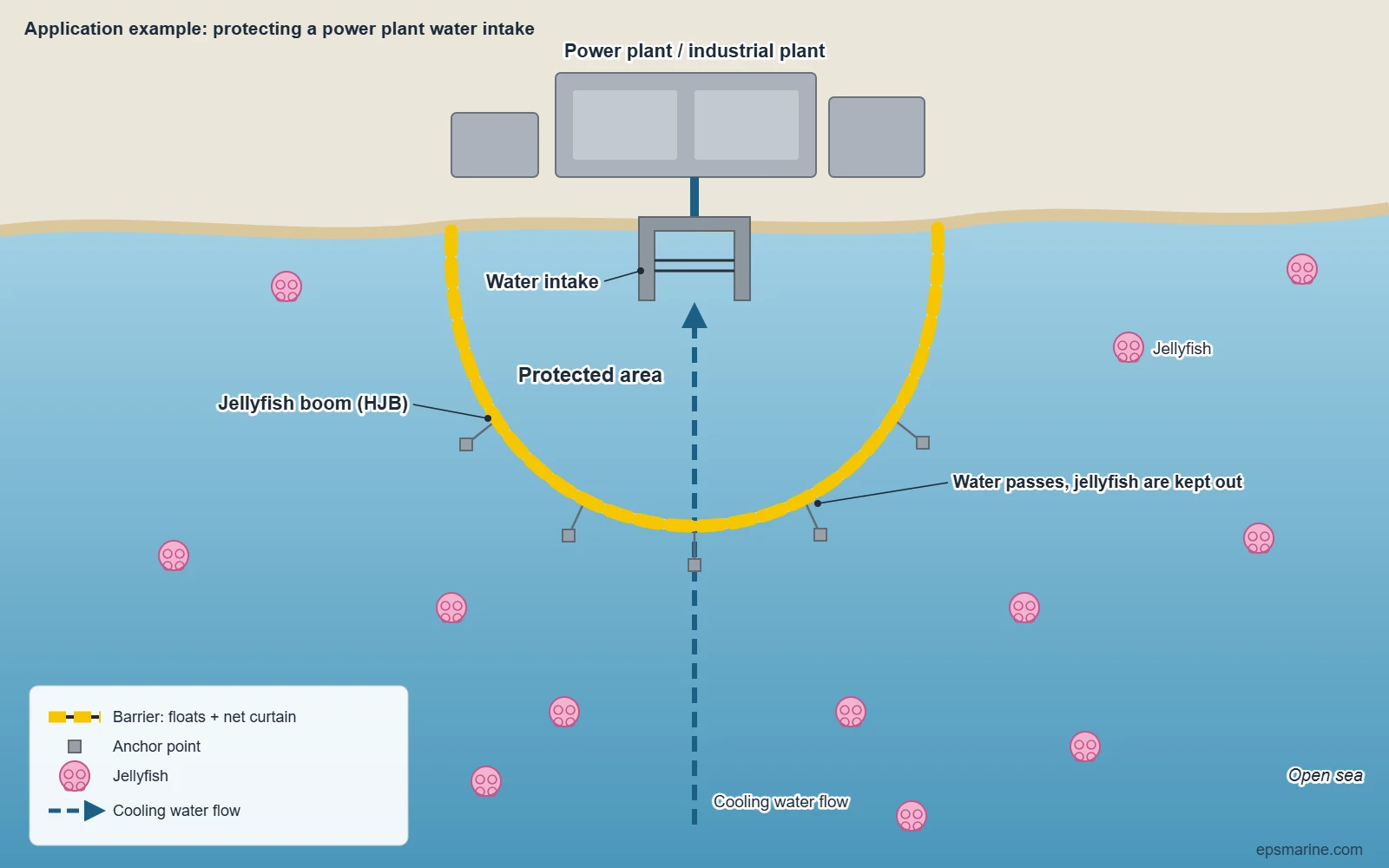
Installed in front of the intake, a jellyfish boom stops jellyfish and floating debris before they reach the structure. The HJB is the model of choice for cooling water intake protection:
- Designed for permanent sea-water service.
- Net depth up to 10 m, to suit the water depth.
- Mesh size down to 15 x 15 mm.
- The net can be detached from the boom and re-attached for cleaning and maintenance.
- A complete anchoring set from the barrier to the seabed (anchor blocks, chains and fittings) is available on request.
- Thanks to its 2-in-1 design, the same line also acts as an oil boom against surface oil pollution.
Typical sites: thermal and gas-fired power plants, desalination plants, refineries and petrochemical plants, and other industrial plants with sea-water intakes.
What to Consider When Selecting a Barrier for a Water Intake
- Mesh size: A smaller mesh is not always better: it increases the solid area of the net, the resistance to water flow and the load on the anchoring. The right choice balances jellyfish retention against water permeability. Because jellyfish are deformable, the mesh is selected not only by bell diameter but by the smallest size to be retained and the effect of the current.
- Net depth: The net does not always need to reach the seabed; a partial curtain covering the water layer where jellyfish concentrate can also be chosen. A deeper curtain retains more jellyfish but also increases the forces on the barrier.
- Layout: A barrier installed across the current retains jellyfish directly. A barrier installed at an angle to the current diverts jellyfish to one end, towards a collection and cleaning area, reducing build-up in front of the barrier.
- Clogging and cleaning: During peak periods the net can fill quickly. The barrier should be cleanable section by section, the net should be removable when needed and damaged sections should be replaceable. On the HJB, the net is attached with shackles and can be detached and re-attached for cleaning and maintenance.
- Mode of use: The barrier can be installed permanently all year (HJB) or deployed only during the jellyfish season or when an influx is expected. In the second case the barrier is stored near the plant and deployed quickly when needed; the LJB, which can be deployed quickly with minimal manpower, suits this use.
Jellyfish Net for Hotels, Beaches and Marinas
At resorts, hotels and beaches, a jellyfish net protects swimmers and marks out the swimming area. The HJB suits installations that stay in place all year; for summer-only installations or sheltered bays, the lightweight LJB can be deployed quickly with minimal manpower. In marinas and harbours, it keeps jellyfish and floating debris out of a defined area.
To mark out swimming areas and keep floating debris off the shore, see also our Beach & Coastal Protection Boom.
HJB – Heavy Jellyfish Boom
The HJB combines the EPS Permanent Boom with a heavy-duty net curtain – one barrier that contains floating oil on the surface and keeps jellyfish out below it. Rotomoulded PE floaters are bolted on both faces of the oil and UV resistant boom fabric with stainless steel bolts, and the sections are joined with ASTM connectors. The net is attached to the bottom of the boom with shackles and can be detached and re-attached for cleaning and maintenance; a ballast chain in a PVC pocket keeps the lower edge of the net in place.
- 2-in-1: permanent oil containment boom and jellyfish net
- Designed for permanent sea-water service
- Detachable net, connected to the boom with shackles for easy maintenance
- Net depth from 1 m to 10 m, to suit the water depth
- Wide choice of mesh sizes, from 15 x 15 mm to 100 x 100 mm
- Highly visible yellow / orange floaters
HJB Technical Specifications
| Boom | EPS Permanent Boom, 500 mm total height (250 mm freeboard / 250 mm draft) as standard; other heights on request |
| Floaters | Rotomoulded PE, yellow / orange, bolted on both faces with stainless steel bolts and nuts |
| Boom fabric | Oil, UV and abrasion resistant |
| Connectors | ASTM end connectors on every section |
| Net material | HDPE, UV stabilised |
| Mesh | 15 x 15, 20 x 20, 30 x 30, 50 x 50 or 100 x 100 mm diamond mesh |
| Net depth | 1 – 10 m, to suit the water depth |
| Net connection | Detachable; shackles along the bottom of the boom |
| Ballast | Galvanised chain in PVC pocket at the bottom of the net |
| Section length | 25 m standard; other lengths on request |
| Anchoring | Complete anchoring set from barrier to seabed (anchor blocks, chains and fittings) available on request |
Modular HJB for Water Intakes
For power plant and industrial water intakes, the HJB is also built as a modular system made of two functionally distinct parts:
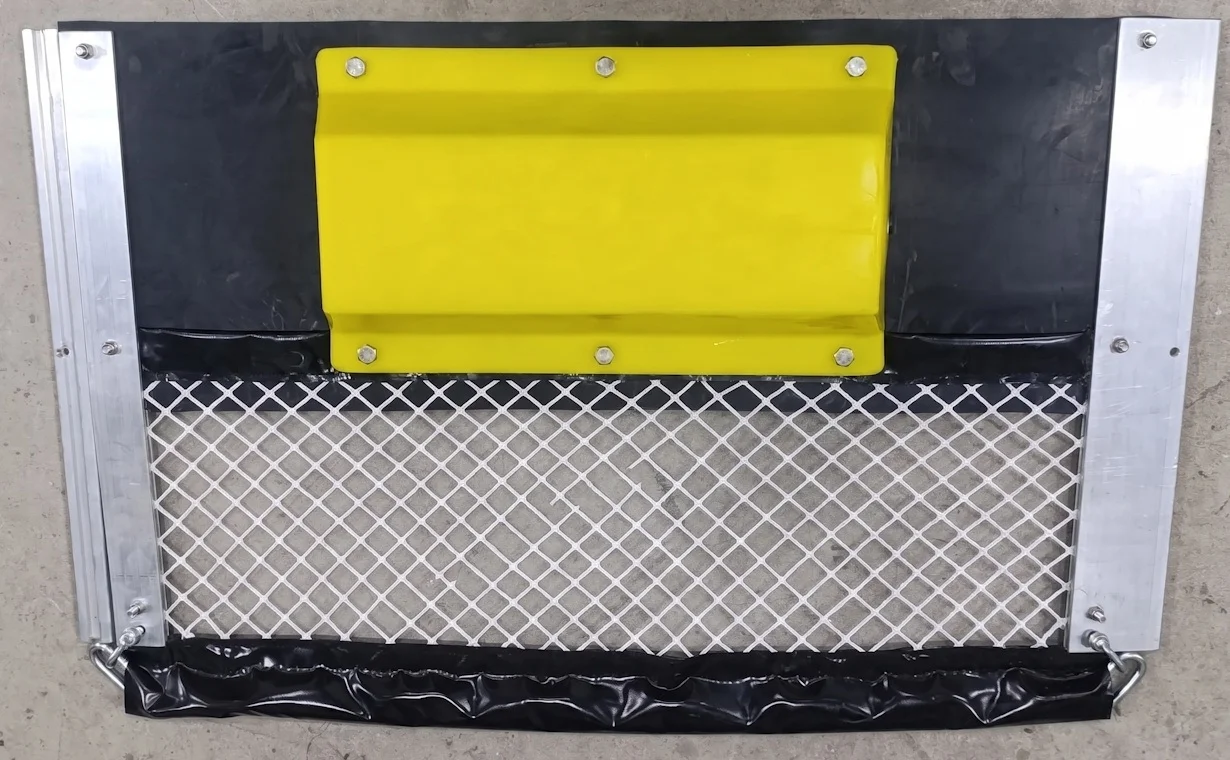
- Fixed body: a rugged 60 cm tall body made of 8 mm rubber panel that stays in the water long-term and carries the flotation, the end connectors and the structural load path between modules.
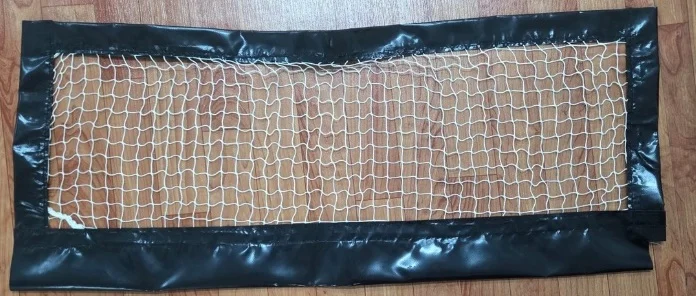
- Replaceable net skirt: the net skirt is fixed below the body with stainless steel bolts and can be unbolted and replaced in the field without disturbing the body or its connectors.
This split keeps the parts that must survive years of marine exposure rugged and simple, while the net, which does the actual jellyfish-exclusion work and is most exposed to fouling, snagging and wear, is designed as the part to be swapped out.
| Body height | 60 cm |
| Body panel | 8 mm rubber |
| Float | Hard HDPE shell, foam-filled core |
| Module end connector | ASTM F962 “Z” type, full height of the body |
| Center connector | Quick-pin connector on the body |
| Net skirt depth | To client specification |
| Skirt frame | Seatbelt-type woven webbing |
| Net | HDPE trawl net |
| Mesh size | To client specification (for example 20 mm or 50 mm) |
| Skirt-to-body fixing | AISI 316 stainless steel bolts and nuts at 500 mm pitch; net panel independently removable |
| Module-to-module connection | Full-height male/female connector on the side edges, 250 mm pitch |
| Safety strap | Runs the length of the skirt to prevent accidental separation |
| Ballast | 10 mm chain in a bottom pocket along the full module length |
| Anchoring | AISI 316 stainless steel D-shackle at each chain end (optional) |
| Module length | 5 – 20 m, to client specification |
LJB – Light Jellyfish Boom
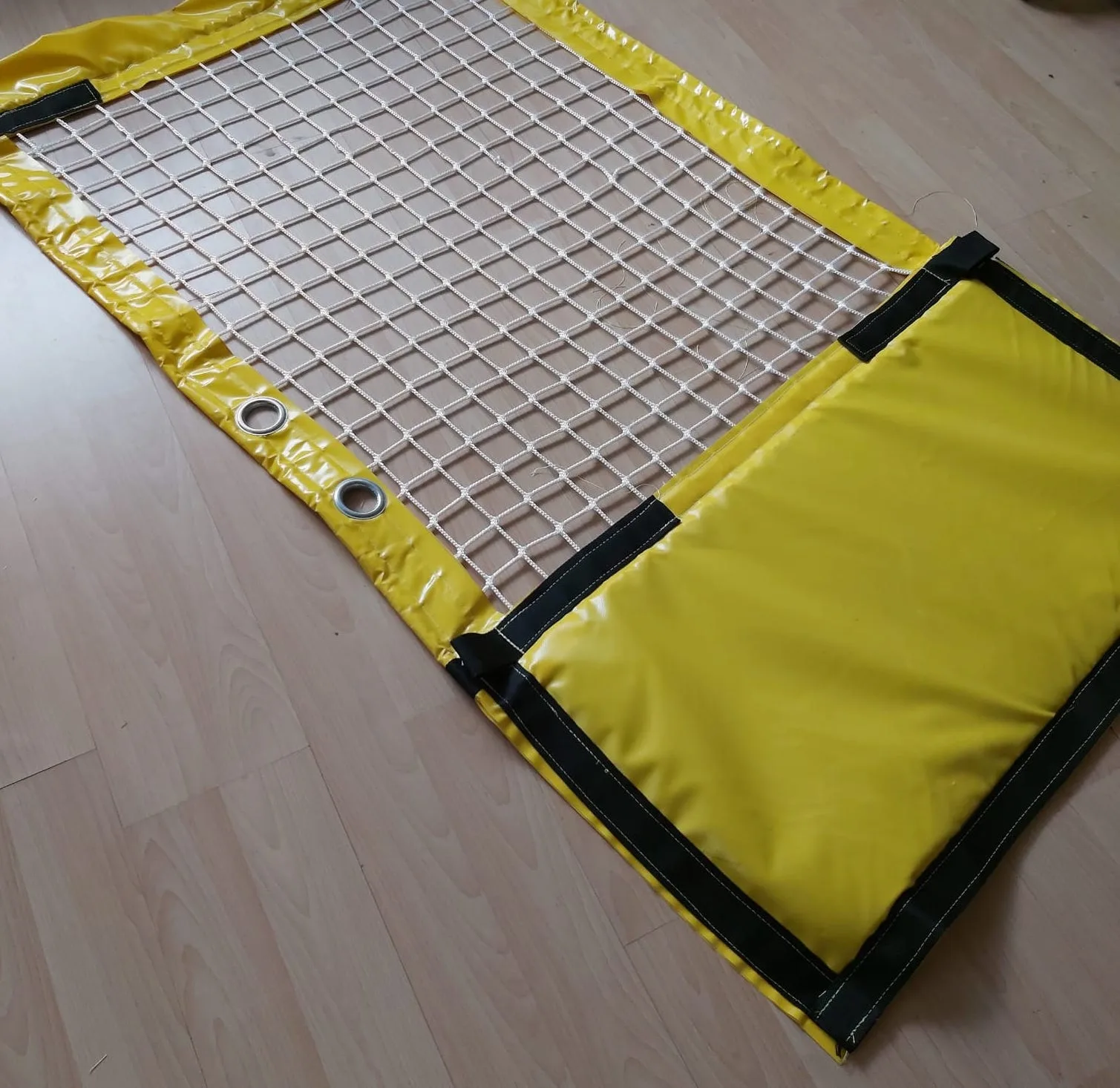
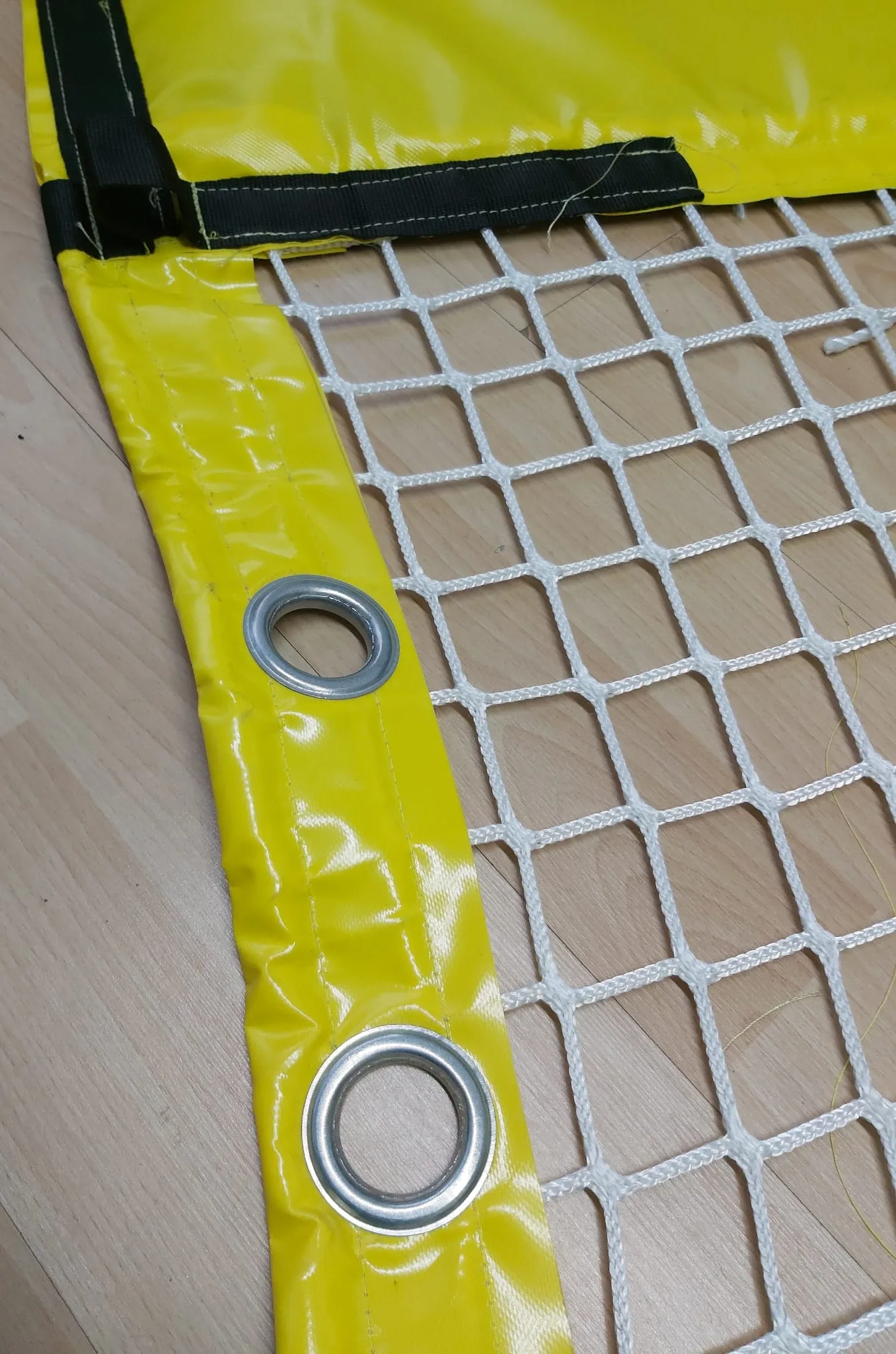
The LJB is a foam-filled net boom manufactured with highly visible yellow / orange PVC coated fabrics. It derives its flotation from resilient closed cell foam, and a galvanised ballast chain is incorporated into the skirt for stability. Each section has reflectors so that boat radars can easily detect the net. The LJB is user friendly and can be deployed with minimum manpower.
- Rapid deployment
- Quick and safe to deploy with minimal manpower
- Durable and long lasting
- Easy connection with ropes
- PVC coated polyester construction
- Galvanised chain as ballast weight
- Mesh size 20 x 20 mm, 1.5 mm thick (other mesh sizes from 15 x 15 mm to 100 x 100 mm available)
- Net material HDPE
LJB Technical Specifications
| Model | Total Height | Freeboard | Net Height | Buoyancy | Section |
| LJB 1500 | 1700 mm | 200 mm | 1500 mm | 1:4 | 25 m |
Available in total heights from 500 mm to 3000 mm.
FAQ
How does a jellyfish boom work?
The floating boom stays on the surface and the net curtain attached to it hangs down towards the seabed, held in place by a ballast chain along its lower edge. Jellyfish and floating debris cannot pass through the net and stay outside the protected area.
Which model is suitable for a power plant water intake?
The HJB is recommended for intakes that need a permanent installation: it is designed for permanent sea-water service, the net depth goes up to 10 m, the mesh size goes down to 15 x 15 mm and the net can be detached for cleaning. Net depth, mesh size and anchoring are selected according to the water depth and conditions at the site.
What is the difference between the HJB and the LJB?
The HJB is a heavy-duty barrier combining the Permanent Boom with a net, for permanent, year-round installations; it also works as an oil boom. The LJB is a lightweight foam-filled net boom for seasonal or sheltered locations that can be deployed quickly with minimal manpower.
How are the net depth and mesh size selected?
The net depth is selected according to the water depth at the site: 1 to 10 m for the HJB, and 500 to 3000 mm total height for the LJB. Mesh size can be selected from 15 x 15 mm to 100 x 100 mm. We make the selection together with you based on the conditions at your site.
Can the net be cleaned?
Yes. On the HJB the net is attached to the bottom of the boom with shackles and can be detached and re-attached for cleaning and maintenance. On the modular HJB for water intakes, the net skirt is fixed to the body with stainless steel bolts and can be replaced in the field without disturbing the body.
What section lengths are available?
Both models are supplied as standard in 25 m sections. Section length, net depth and mesh size can be modified according to the requirements of the project. The modular HJB for water intakes can be supplied in 5 to 20 m modules.
Is a smaller mesh size always better?
No. As the mesh gets smaller, the solid area of the net, the resistance to water flow and the load on the anchoring all increase. The right mesh size is selected according to the smallest jellyfish to be retained and the required water permeability; we evaluate the options from 15 x 15 mm to 100 x 100 mm together with you based on the conditions at your site.
Does the net need to reach the seabed?
Not always. The net can also be a partial curtain deep enough to cover the water layer where jellyfish concentrate. A deeper curtain retains more jellyfish but also increases the forces on the barrier. On the HJB, the net depth can be selected from 1 to 10 m.
Can the barrier be installed only during the jellyfish season?
Yes. The barrier can be installed permanently all year or deployed only during the jellyfish season or when an influx is expected. The HJB is recommended for permanent installations, and the LJB for seasonal use where quick deployment with minimal manpower is needed.
Request a Quote for a Jellyfish Boom
Tell us the installation site (water intake, beach or marina), the barrier length you need and the water depth, and we will prepare a quote with the right model, net depth and mesh size.
Dimensions and specifications can be modified according to the requirements of the project.